






Most games tolerate speedrunning. A smaller subset accommodates it. Neon White does something more radical: it builds its entire mechanical architecture around it. Rather than treating speedrunning as a community-imposed layer atop finished systems, the game integrates time optimization into its primary progression loop. Every mechanic, enemy placement, shortcut, and reward tier is calibrated to encourage replay at increasing levels of precision.
This article examines how Neon White collapses the boundary between first-time completion and mastery. By embedding ranking thresholds, card-based mobility mechanics, and visible global leaderboards directly into the campaign structure, the game reframes repetition as progression rather than redundancy.
1. First Completion as Incomplete Understanding
Clearing a level once in Neon White feels functional but insufficient.
The player reaches the exit, eliminates enemies, and survives. Mechanically, the task is complete. Structurally, it is not.
The immediate display of medal times reframes the run as preliminary reconnaissance. Completion becomes merely the first draft.

2. Medal Thresholds as Behavioral Incentives
Each stage includes Bronze, Silver, Gold, and Ace time targets.
These thresholds are not cosmetic. They unlock narrative dialogue, side missions, and progression advantages.
Embedded performance economy
Speed is directly tied to advancement, making optimization mandatory for full access.
This shifts player mindset from survival to refinement.
3. Cards as Dual-Purpose Mobility Tools
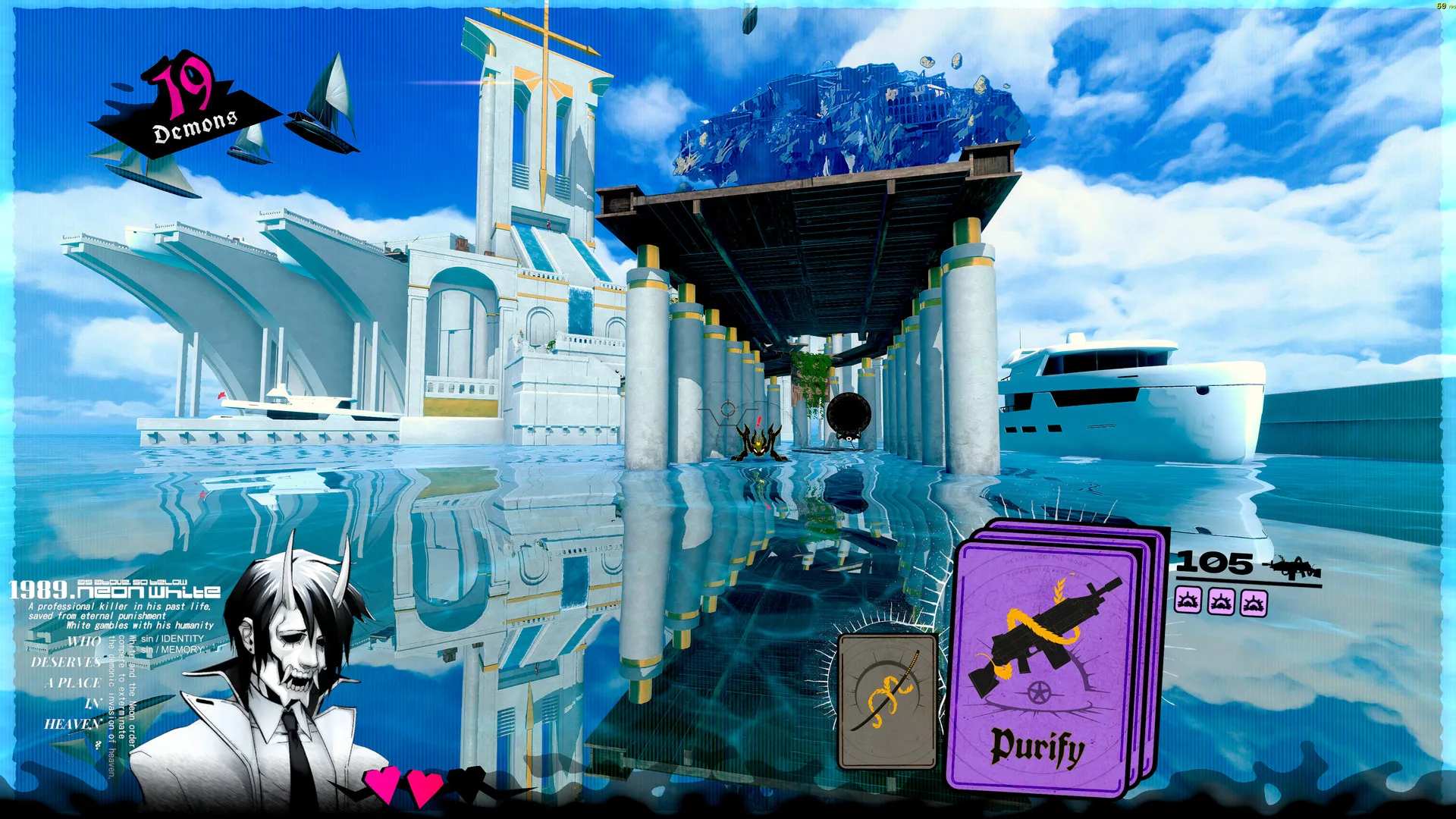
Weapons in Neon White double as movement abilities.
Discarding a card activates a mobility action: dashes, double jumps, ground pounds.
Resource-mobility fusion
Combat efficiency and traversal efficiency are inseparable.
Optimal speed demands precise resource sequencing.
4. Level Geometry Built for Route Discovery
Levels are compact but vertically layered.
Hidden shortcuts and alternate paths are intentionally visible but initially unreachable without experimentation.
Spatial transparency
The design signals that faster routes exist.
Players are invited to question their first solution.
5. Instant Restart and Frictionless Iteration
A single button resets a level instantly.
There are no loading screens or punitive delays.
Iteration fluidity
The absence of friction transforms repetition into rhythm.
Failure becomes momentum rather than setback.
6. Leaderboards as Structural Motivation
Global and friend-based leaderboards are integrated directly into level results.
Times are not abstract statistics hidden in menus.
Visible comparison
Performance exists in a shared competitive space.
The design normalizes continual optimization.
7. Enemy Placement as Movement Puzzle
Enemies are positioned less as threats and more as trajectory nodes.
Killing them efficiently often extends mobility chains.
Combat as propulsion
Engagement is a means to preserve speed.
Hesitation disrupts flow more than danger does.
8. Dialogue Interruptions and Pacing Control
Narrative segments occur between missions, not during them.
Levels themselves are uninterrupted kinetic bursts.
Compartmentalized storytelling
This structure preserves the integrity of speed-focused gameplay.
Emotional beats never intrude on performance loops.

9. Skill Ceiling Through Micro-Optimization
Achieving Ace medals often requires shaving tenths of seconds.
Subtle angle adjustments and perfect discard timing become decisive.
Precision escalation
The gap between Gold and Ace represents mastery, not luck.
The design rewards obsessive refinement.
10. Why Speedrunning Must Be Structural, Not Emergent
If speedrunning were optional, repetition would feel elective.
Neon White avoids this by embedding time pressure into narrative and reward systems.
By doing so, it eliminates the divide between casual completion and elite performance. The game does not ask whether you want to optimize. It assumes you will.
Conclusion
Neon White redefines the relationship between player and replayability. Instead of designing levels to be consumed once and optimized externally by dedicated communities, it internalizes speedrunning as the fundamental grammar of play. Completion is reconnaissance. Repetition is refinement. Mastery is expected.
Through medal thresholds, card-based mobility, and frictionless restarts, the game creates a tightly wound loop where improvement feels inevitable. Neon White does not celebrate speedrunning as an achievement beyond the game—it embeds it at the heart of its identity, ensuring that the fastest path is also the intended one.