.webp)





The Technological Sublime: A Deep Dive into the Industrial Ecology of Arknights: Endfield
The dawn of Arknights: Endfield represents more than just a mechanical shift from the tower-defense roots of its predecessor; it is a profound ontological expansion of the "Terra" mythos. As players step into the boots of the Endfield Administrator on the desolate, wind-swept plains of Talos-II, they aren't just engaging in an Action-RPG—they are participating in the systematic reconstruction of a civilization. The core of this experience isn't found in the combat numbers or the gacha rates, but in the Automated Industrial Ecology. This system serves as a bridge between the wild, entropic nature of a new planet and the rigid, mathematical order of a space-faring society.
To understand Endfield is to understand the struggle against the "Blight," a physical and metaphysical corruption that renders land uninhabitable. The game’s brilliance lies in how it frames its industrial systems not as a secondary "base-building" minigame, but as the primary narrative and mechanical engine of the world. We are not just tourists on Talos-II; we are the architects of its literal lifeline. In this deep dive, we will explore the philosophical and technical intricacies of the Integrated Factory System (IFS) and how it defines the identity of Endfield as a pioneer in the "industrial-adventure" subgenre.
1. The Conceptual Genesis: Industrialism as a Narrative Pillar

In most RPGs, industry is a backdrop—a forge in a town or a static crafting menu. In Arknights: Endfield, the factory is a living organism. The developers at Hypergryph have infused the game with a "Techno-Industrialism" aesthetic that emphasizes the weight, sound, and spatial requirements of machinery. The narrative posits that Talos-II is a "dying" or "unborn" world, and only through the rigid application of industrial logic can humanity carve out a sanctuary. This creates a unique ludonarrative harmony: as the player, your desire for better gear directly aligns with the world’s need for expanded infrastructure.
The concept of "The Administrator" is central to this. Unlike the Doctor in Arknights, who is a tactical mastermind of biological warfare and Originium research, the Administrator is a logistics god. Every pylon placed and every conveyor belt routed is an act of defiance against the chaos of the frontier. The game treats the construction of a power grid with the same gravitas that other games treat a boss fight, suggesting that the true hero of Talos-II isn't a sword-wielder, but the network that powers the sword.
2. Spatial Logic: The Geometry of the Integrated Factory System
The Integrated Factory System (IFS) is the mechanical heart of Endfield, and its complexity starts with spatial awareness. Unlike grid-based builders, Endfield requires players to account for the verticality and jagged topography of Talos-II. You cannot simply drop a refinery anywhere; you must consider the proximity to resource nodes, the elevation for power transmission, and the physical footprint of the machinery. This creates a "puzzle-like" layer to exploration where players aren't just looking for treasure, but for "buildable sites" that can support a heavy industrial load.
The beauty of this system lies in the Conveyor Belt Dynamics. These aren't just visual indicators of item movement; they are physical entities that require routing, splitting, and merging. A poorly designed factory leads to "logistics bottlenecks," where production grinds to a halt because a single belt is overloaded or misaligned. This forces the player to think like a systems engineer, optimizing the flow of raw minerals into refined components, then into advanced weaponry, all while maintaining a visually cohesive and functional base.
The Architecture of Efficiency
To master the IFS, one must understand the hierarchy of construction. It begins with the extraction of raw materials, followed by the secondary processing phase, and finally the synthesis of high-tier items. This flow is physically represented on the map, creating a sprawling metallic web that stands in stark contrast to the organic ruins of the planet.
3. Power Distribution: The Arterial Network of Talos-II
Energy is the most precious resource in Endfield, and its distribution is handled through a sophisticated "Power Pylon" system. Every machine requires a specific wattage, and your overall power capacity is determined by your central generators. However, power doesn't just "exist" across your base; it must be transmitted. This introduces the concept of Grid Integrity. If a Pylon is destroyed by roaming monsters or misplaced during an expansion, entire sectors of your production can go dark, halting your progress and leaving your defenses vulnerable.
This creates a high-stakes environment where the player must protect their power lines as fiercely as their characters. The visual storytelling of seeing a dark, silent factory suddenly roar to life as you connect the final pylon is a core dopamine loop of the game. It reinforces the idea that life on Talos-II is artificial and maintained through constant, vigilant effort. The grid isn't just a mechanic; it’s a manifestation of human will imposed upon a hostile environment.
4. The Blight and Environmental Entropy
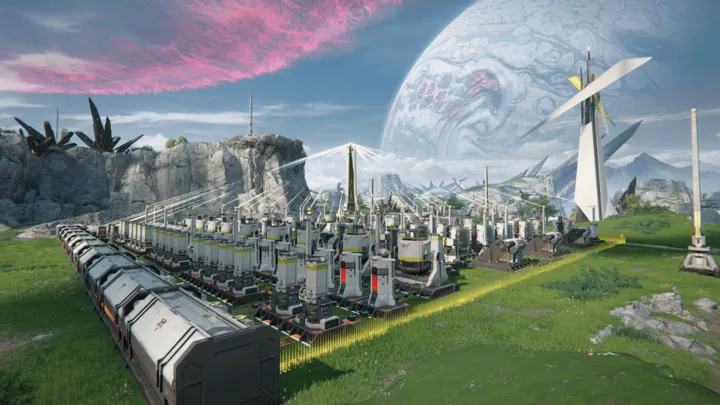
Standing in direct opposition to your industrial progress is the Blight. This isn't just a "bad area" on the map; it is a corrosive force that eats away at structures and complicates the logistics of Talos-II. The Blight represents environmental entropy—the natural state of the planet trying to reclaim what the Administrator has built. In areas heavily affected by Blight, standard machinery may malfunction or require specialized "Anti-Blight" shielding, adding a layer of tactical preparation to your industrial expansion.
This creates a cyclical gameplay rhythm: expansion, corruption, and purification. You don't just "clear" a zone; you industrially sanitize it. By placing purifiers and building robust supply lines through blighted zones, you are effectively pushing back the fog of war with steel and electricity. It turns the act of "cleaning the map" into a tangible, mechanical process rather than just a narrative checkbox.
Types of Environmental Hazards
- High-Density Blight: Rapidly damages structures and requires advanced filtration.
- Ionization Storms: Temporarily disrupts power grids and automated drones.
- Seismic Instability: Can break conveyor belt connections, requiring manual repair.
5. Resource Metamorphosis: From Dust to Divinity
The alchemy of Endfield lies in its resource tiers. The game moves from basic ores like iron and copper to complex, fictional isotopes unique to Talos-II. Each step in the refinement process is a "Metamorphosis." You aren't just making a better sword; you are mastering the atomic structure of the planet. The high-tier manufacturing plants in the late game are massive, multi-story structures that require hundreds of smaller components to build, making the final product feel earned through hours of systemic planning.
This progression is tied directly to the "Technological Tree." Unlike traditional RPG trees that unlock passive buffs, Endfield’s tree unlocks Capabilities. Unlocking a new tier of smelting doesn't just give you +5 Attack; it changes the entire layout of your factory, allowing for more compact designs or higher throughput. This makes the "meta" of the game about the evolution of your infrastructure rather than just the leveling of your party.
6. Automated Combat Integration: The Turret Meta
In Endfield, combat and industry are not separate silos. Your factory can be upgraded to include defensive perimeters, creating a "Tower Defense" hybrid experience within the open world. Automated turrets, missile batteries, and slow-field generators can be integrated into your power grid. This allows the player to lure dangerous "Aggelos" (the game's primary antagonists) into "kill zones" that you have meticulously engineered. It’s a satisfying convergence of your logistical hard work and the game’s real-time action.
The efficiency of these defenses depends entirely on your factory's output. A turret with no ammo production line is just a heap of metal. Therefore, the player must balance "Consumer Production" (items for the characters) with "Defense Production" (ammunition and repairs). This "Total War" economy ensures that every part of your base has a functional purpose during the game’s more intense combat encounters.
7. The Human Element: Operator Synergy in Industry
While the machines do the heavy lifting, the Operators provide the "Soul" of the factory. Each character in Endfield has specific "Industrial Talents." Some might increase the speed of a refinery, while others reduce the power consumption of the grid. This adds a layer of team-building that goes beyond combat stats. You might find yourself pulling for a character not because they have a high-damage Ultimate, but because they are the only ones who can optimize your high-tier electronics plant.
This creates a fascinating dynamic where your "combat team" and your "factory team" might be completely different. It encourages players to value their entire roster. A low-rarity Operator might be a mediocre fighter but a "Master of Logistics," making them indispensable to your base’s efficiency. This deepens the bond between the player and the characters, as they aren't just tools for killing, but partners in building a future.
8. Technical Logistics: The UI and Management HUD
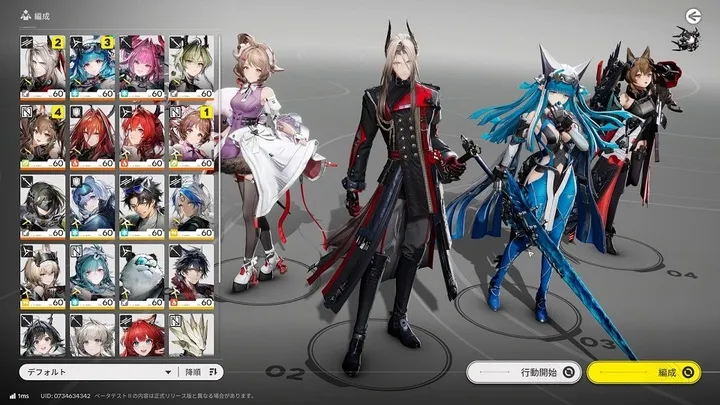
Managing a planet-wide industrial network requires a world-class interface, and Endfield delivers a "Tactical Management HUD" that feels like a professional engineering suite. The game allows for a bird's-eye "Construction Mode" where the world turns into a blueprint, allowing for precise placement of belts and pipes. This UI is critical for diagnosing issues; heat maps show power drains, and flow-indicators show where resources are piling up.
The complexity of the UI is a badge of honor for the game. It doesn't shy away from data. For the "min-maxer," there are menus detailing items-per-minute and energy-conversion-ratios. For the casual player, the visual cues of a spinning gear or a glowing light are enough to indicate success. This dual-layered feedback system makes the daunting task of planetary management accessible without sacrificing the depth that "Factorio-style" enthusiasts crave.
9. The Ethics of Extraction: A Narrative Undertone
Beneath the satisfying "clink" of the machines lies a deeper philosophical question that Endfield subtly asks: at what cost do we settle Talos-II? The act of stripping a planet of its resources to power a mechanical civilization is a recurring theme in the Arknights universe. As the Administrator, you are essentially an agent of "Endfield Industries," a mega-corporation. The game occasionally hints at the environmental impact of your industrial sprawl, suggesting that the Blight might be a localized immune response from the planet itself.
This adds a layer of "Corporate Noir" to the experience. You are building a miracle, but you are also an interloper. The industrial aesthetic—heavy, brutalist, and uncompromising—reflects this. Your base isn't a "home"; it’s an extraction site that looks like a fortress. This tension between the wonder of technology and the cold reality of colonization gives Endfield a mature, thought-provoking atmosphere that sets it apart from more whimsical fantasy RPGs.
10. Conclusion: The Legacy of the Administrator
Arknights: Endfield is a monumental achievement in merging two disparate genres: the open-world Action-RPG and the deep-system Industrial Sim. By making the factory the protagonist of the world-building process, Hypergryph has created a game where every player’s journey is etched into the landscape of Talos-II in the form of steel, wires, and light. The "Industrial Ecology" of Endfield isn't just a set of menus; it is a profound exploration of how humanity uses logic and labor to survive the impossible.
As we look toward the future of the franchise, the Administrator’s role will only grow more complex. The true joy of the game isn't just in reaching the end of the story, but in looking back from a high mountain peak at the sprawling, glowing network of industry you’ve created—a testament to order in a world of chaos. On Talos-II, the machine is the message, and the message is that we are here to stay.